Saturday, March 20, 2010

World Comission on Environment and Development


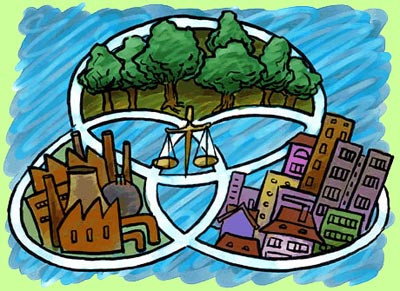
This article goes into depth about sustainable development and what is required for development to be considered sustainable. "Sustainable development is what meets the needs of the present without compromising the ability of future generations to meet their own needs. It contains within it two key concepts: "The concept of "needs", in particular the essential needs of the world's poor, to which overriding priority should be given; and the idea of limitations imposed by the state of technology and social organization on the environment's ability to meet present and future needs". "A world in which poverty and equity are endemic will always be prone to ecological and other crisis." The fact that much of the world can't satisfy their basic needs means that they will always value their lives and those of their families above ecological integrity. This requires economic growth in places were there is none. "But growth by itself is not enough. High levels of productive activity and widespread poverty can coexist, and can endanger the environment. Hence societies meet human needs both by increasing productive potential and by ensuring equitable opportunities for all."
Sustainable development also means minimizing the amount of human intervention on the natural systems that supports life on earth. "Economic growth and development obviously involve changes in the physical ecosystem. Every ecosystem everywhere cannot be preserved intact. A forest may be depleted in one part of a watershed and extended elsewhere, which is not a bad thing if the exploitation has been planned and the effects on soil erosion rates, water regimes, and genetic losses have been taken into account." Conservation is also very important because more extinction means less diversity for the future meaning less options.
"In essence, sustainable development is a process of change in which exploitation of resources, the direction of investments, the orientation of technological development, and institutional change are all in harmony and enhance both current and future potential to meet human needs and aspirations." Individuals need to be persuaded to take sustainable action but that can be difficult so the benefits must be presented, benefits in the short term or present are usually more effective than those in the long term.
"The common theme throughout this strategy is sustainable development is the need to integrate economic and ecological considerations in decision making. They are after all, integrated in the workings of the real world. This will require a change in attitudes and objectives and in institutional arrangements at every level."

Citations:
Towards Sustainable Development by: The World Commission on Environment and Development.

Picture:
http://psysr.files.wordpress.com

Thursday, March 11, 2010

Blog Reflection


The following readings and activities were about the food industry. How it was, How it is, and what it may be like in the future. Food is is an element that is essential to life. If we were to stop burning fuel for energy and stopped harvesting materials for shelter we would still survive, (there are some who live in the world today with neither). But without food life would be impossible. As Carol Steel pointed out civilization (urbanism) itself was possible only with agriculture at the center.

Like every other resource given to us as a species we have managed to overuse and destroy food materials and an alarming rate even without the entire population benefiting from it. The affluent western society has expanded and grown out of control. Farmers have been forced from a lifestyle of quality, health and sustainability to a world of quantity, a unsustainable and uncertain future.

I looked at my own diet for the first time in this light. In the last 48 hours everything aside from a few fruits and vegetables were frozen and packaged at one time or another and most likely shipped large distances at one time. Most of the fruits I eat are those grown in California and Florida because they cheapest foods at the store. I drink alot of milk and I eat meat often though not on a daily basis. What I see as more relevant is how disconnected I am from what I eat. Once its gone I forget it was ever there. The only time I think of food is when I'm contemplating what to have next. This blind consuming is habit of the majority of people today especially urban-living people. It has come to the point were everybody is fixated on there own business. It would require an unnecessary amount of time for most to think about what they are actually eating, where it came from, and where the leftovers will end up. When I think about my own diet I realize that my taste for extravagance is an issue. I do not like eating the same thing within a few days this requires more exportation of a wider variety of produce. But I have made it a habit of eating whats on my plate so my waste is usually minimal, I also have the luxury of living in a city surrounded by agriculture so much of my food doesn't have to travel far. I can easily take more action on the problem in buying local, I would greatly reduce my footprint without hindering curious appetite.

Photo:
http://www.liquidmatrix.org/blog/

How Food Shapes Our Cities


Carolyn Steel examines the deep connection of people to food past and present. She describes how city weas shaped around food in pre-industrial times. City markets were the center of urban settlements which was the social fabric of the community. Buying food was back then the opportunity to socialize and network with others throughout the settlement. "Ounce (food) roots in the city are established they very rarely move". Society lived with food at the center food was how humanity is connected to nature. But "after the trains came cars and this marks the end of this process, its the final emancipation of the city from any apparent relationship with nature at all." It meant that meat did not need to be brought in the city but outside and out of society as well as grains and crops could be moved greater distances in less time preventing it from going bad. Before "cities used to be constrained by geography"
The connection with nature and essentially the social fabric that came along with buying food was gone. Now it is possible to drive to the grocery store and buy your food and not talk to anyone but the cashier. The sacred significance of food was lost "we don't value food, we don't trust it instead of trusting it we fear it, and instead of valuing it with throw it away". This has distanced us from nature and is unsustainable "A billion of us are obese and another cant get enough". "It takes 10 calories (of fossil fuel) to produce 1 calorie of food in the western world". "A 3rd of annual grain crop is fed to animals". These are just a few examples that Steel shares about current food produce and eating practices.
Her solution is to somehow put food back into the center of life. More people are needed to think about food on a regular basis be it male or female. She imagines a utopia or "sitopia" as she calls it where all society is once again focused and centralized around food. "sitopia exist as little pockets everywhere the trick is to join them up." The solution the global food crisis will involve a change in the public's opinion toward food. "We know we are what we eat we need to realize that the world is also what we eat."

Citations: www.ted.com
by Carolyn Steel

Picture:
http://farm2.static.flickr.com/

Women's Indigenous Knowledge and Biodiversity Conservation


Vandana Shiva suggests that ecological exploitation is linked to female exploitation. She describes how "Women as farmers, have remained invisible despite their contribution. Economists tend to discount woman's work as "production" because it falls outside the so-called "production boundary". These omissions arise not because to few women work, but too many women do too much work of too many different kinds." Because the work done by women of rural communities cannot be measured in wages their contribution is usually overlooked. It is in the variety of contributions of women that makes them "custodians of biodiversity". "There are a number of crucial ways in which the Third World woman's relationship to biodiversity differs from corporate man's relationship to biodiversity. Women produce through biodiversity, whereas corporate scientists produce through uniformity. For women farmers, biodiversity has intrinsic value-for global seed and agribusiness corporations, biodiversity derives its value as "raw material" for the biotechnology industry. For women farmers the essence of the seed is the continuity of life. For multinational corporations, the value of the seed lies in the discontinuity of its life. Seed corporations deliberately breed seeds that cannot give rise to future generations so that farmers are transformed from seed custodians into seed consumers." "Patents on seeds are thus a twenty-first century form of piracy, through which the shared heritage and custody of third world women peasants is robbed and depleted by multinational corporations, helped by global institutions like GATT (General Agreement on Tariffs and Trade)." Though GMOs have not yet been proved unsafe Shiva states that the same groups who we are supposed to trust with GMO food are the same companies that gave us pesticides in our food. As Jack Kloppenberg has recently said, "Having been recognized as wolves, the industrial semioticians want to redefine themselves as sheep, and green sheep at that."

Citations:
Women's Indigenous Knowledge and Biodiversity Conversation.
by: Vandana Shiva

Photo:
http://sdaenvironmentalism.files.wordpress.com/

Wednesday, March 10, 2010

The Agricultural Crisis as a Crisis of Culture


Wendell Berry examines the cultural shift of small family farming to large industrialized agriculture. Farming communities are being reduced in size to make room for the crops of big business. The desire for greater efficiency and production has replaced workmanship pride and the culture that came with it. Before this most food produced was raised by the families themselves or as a collaborative effort of the entire community. When modern mechanized farming techniques profits became greater due to technological advances the benefits became more centralized to those who exploited it the most. "I remember, during the fifties, the outrage with which our political leaders spoke of the forced removal of the populations of villages in communist countries. I also remember that at the same time, in Washington, the word on farming was "Get big or get out" -a policy which is still in effect and which has taken an enormous toll. The only difference is that of method: the fore used by the communists was military; with us, it has been economic- a "free market" in which the freest were the richest. The attitudes are equally cruel, and I believe that results will prove equally damaging, not just to the concerns of human value and spirit, but to the practicalities of survival.. And this community killing agriculture, with its monomia of bigness, is not primarily the work of farmers, though it has burgeoned on their weaknesses. It is experts, the bureaucrats, and the "agribuisnessmen," who have promoted so-called efficiency at the expense of community (and of real efficiency), and quantity at the expense of quality." This has shifted the decision making from local farmers to agri-corporations with a personal agenda which is to maximize production and efficiency rather then supply a healthy sustainable communities of the work force. What is lost the is the quality that had been valued so greatly by the previous system, now disregarded more and more by the general public. This is causing catastrophic health and environmental damge as well as a destroying a type of culture that lay the foundation to civilization, the farmer's culture.

Citations:
The Agricultural Crisis as a Crisis of Culture
by Wendell Berry

Photo:
http://scienceblogs.com/sciencepunk/

Tuesday, March 9, 2010

Environmental, Energetic, and Economic Comparisons of Organic and Conventional Farming Systems


This article explains the sustainable benefits to organic farming."The estimated environmental and health care costs of pesticide use at recommended levels and health care costs of pesticide use at recommended levels in the United States run about $12 billion every year." This is mostly attributed to runoff from ground water in lakes and streams used for irrigation as well as drinking water. Because of the health and environmental concerns attributed to pesticide use on cropland there has been a push toward pesticide free farming or organic farming. "The aim of organic agriculture is to augment ecological processes that foster plant nutrition yet conserve soil and water resources. Organic systems eliminate agrochemicals and reduce other external inputs to improve the environment and farm economics."
"From 1981 through 2002, field investigations were conducted at the Rodale Institute FST in Kutztown, Pennsylvania, on 6.1 ha. The soil at the study site is a moderately well-drained Comly silt loam. The growing climate is sub humid temperature." The field was divided into three equal plots one with "The conventional cropping system", based on synthetic fertilizer and herbicide use, represented a typical cash grain, row crop farming unit and used simple 5-year crop rotation (corn, corn, soybeans, corn, soybeans) that reflects commercial conventional operations in the regions throughout the Midwest." Another third was organic "animal-based cropping". "This system represented a typical livestock operation in which grain crops were grown for animal feed not cash sale... Aged cattle manure served as nitrogen source and was applied at a rate of 5.6 metric tons (t) per ha (dry), 2 years out of every 5, immediately before plowing soil for corn." The third and last plot consisted of "organic legume-based cropping". "This system represented a cash grain operation, without livestock. Like the conventional system, it produced a cash grain crop every year; however, it used no commercial synthetic fertilizers, relying instead on nitrogen-fixing green manure crops as a nitrogen source." The results showed a greater amount of carbon retention within the soil in organic methods than conventional. Less fossil fuel was also used during organic farming then conventional. "Except for the 1999 drought year, the crop yields for corn and soybeans were similar in the organic animal, organic legume, and conventional farming systems." "Two primary problems with the organic system... were nitrogen deficiency and weed competition." The nitrogen deficiency was solved with legume crop cover and because organic farming is limited to biological and mechanical deterrents pest control must be handled based on geographic location. The article describes that organic farming not only provides a sustainable solution but a beneficial one as well "although labor inputs average about 15% higher in organic farming systems (ranging from 7% to 75% higher), they are more evenly distributed over the year in organic farming systems then in conventional farming systems."

Citations:
Environmental, Energetic, and Economic Comparisons of Organic and Conventional Farming Systems.
by: David Pimentel et al.

Photo:
http://uwstudentweb.uwyo.edu/

Monday, March 8, 2010

Food Scarcity: An Environmental Wakeup Call


This article speaks upon the environmental crisis of food and water scarcity. These two factors will be were environmental deterioration and economic decline will become parallel in the years to come. Overpopulation is increasing the pressures on the cropland and aquifers. This increases soil erosion and leads less productivity the following years causing food shortages and political instability. The world population is expanding by 80 million people a year. "Even without further environmental degradation, we approach the new millennium with 800 million hungry and malnourished people." With more people becoming more affluent "the amount of cropland available to produce grain will continue to decline, shrinking to 0.08 hectares per person in 2030."
The same can be said for water because it is so crucial to agriculture "since 1979, the growth in irrigation has fallen behind that of population, shrinking the irrigated area per person by some 7%. This trend, now well established, will undoubtedly continue as the demand for water presses ever more tightly against available supplies." More water is also being used for non-food purposes further increasing the drop. "As water is pulled away from agriculture, production often drops, forcing the country to import grain. Importing a ton of grain is, in effect, importing thousands of tons of water. For countries with water shortages, importing grain is the most efficient way to import water."
During the late spring and early summer of 1996 world wheat and corn prices set highs under pressure from a 1995 harvest reduced by heat waves in the U.S. Corn Belt and from China's emergence as the world's second-largest grain importer. Wheat traded at over $7 a bushel, more than double the price in early 1995. In mid-July, corn traded at an all-time high of $5.54 a bushel, also double the level of a year earlier." This increase is catastrophic for the worlds poor. These increases will likely be what forces the world to take more sustainable but desperate action.

Citations: Food Scarcity: An Environmental Wakeup Call
by Lester Brown

Picture:
http://www.inkcinct.com.au/web/cartoons/2007/2007-627P-water-price-scale.jpg